OFFICE NO 5 & 6, 3RD FLOOR,
EARTH ALPHA COMPLEX
VASNA BHAYLI RD, VADODARA
GUJARAT, INDIA

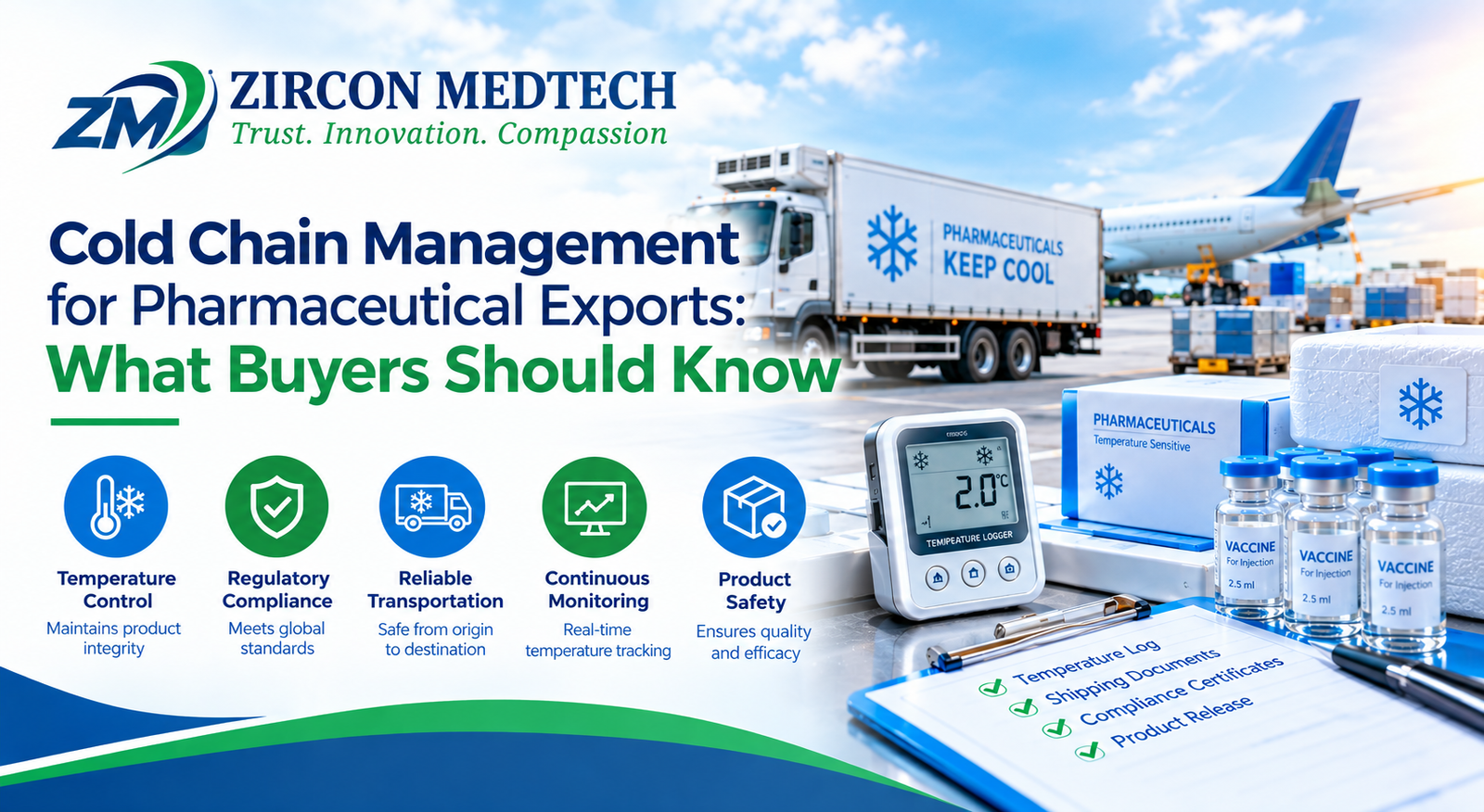
Why Does Cold Chain Management Matter?
Some medicines can deteriorate when exposed to temperatures outside their specified conditions. Depending on the product, excessive heat or freezing may affect stability, potency or other quality characteristics. These changes may not be visible through a simple inspection.
Cold chain management aims to maintain the required temperature conditions throughout the supply journey. WHO guidance addresses the storage and transport controls needed for time- and temperature-sensitive pharmaceutical products.
Buyers should establish the requirements for the exact product before arranging shipment. A general statement that a supplier offers “cold chain shipping” is not sufficient evidence that the proposed arrangements suit every medicine.
What International Buyers Should Check
Before ordering temperature-sensitive medicines, buyers should evaluate the following factors.
1. Product-Specific Storage and Transport Conditions
Confirm the conditions specified in the approved product information and the manufacturer’s instructions.
Some medicines require refrigerated storage, commonly within a range such as 2°C to 8°C. Others require frozen conditions or controlled room temperature. Buyers should not assume that all injections, vaccines or biological medicines have identical requirements.
Check whether the medicine has restrictions relating to freezing, light exposure or time outside its normal storage conditions. Any proposed transport allowance should be supported by appropriate product-specific evidence.
The agreed shipping instructions should clearly identify the required conditions and the product presentation covered.
2. Supplier and Logistics Partner Capability
Buyers should identify who is responsible for preparing, storing and transporting the shipment at each stage.
Ask how the exporter selects and assesses logistics partners, trains personnel and manages handovers. Review whether the facilities and transport systems are suitable for the proposed shipment.
Where subcontractors are involved, establish how requirements are communicated and how their performance is monitored.
The assessment should cover the entire journey, including collection from the supplier, temporary storage, international transport and delivery to the buyer.
3. Qualified Packaging and Shipping Containers
Temperature-controlled packaging should have documented evidence that it can maintain the required conditions under defined circumstances.
Passive systems use insulation and temperature-control materials, while active systems use powered temperature control. The appropriate choice depends on the product, route, shipment size and expected duration.
Buyers should check the approved packing configuration, payload limits, preparation instructions and demonstrated protection period. Packaging qualification should reflect relevant external temperature conditions and the intended use.
Cold packs should not be added or positioned without following the qualified procedure. Incorrect preparation can expose freeze-sensitive medicines to damaging conditions.
4. Transport Route and Delay Planning
A suitable shipping plan should account for more than the scheduled flight or road journey.
Buyers should consider collection times, airport handling, transit connections, customs clearance, weekends and delivery arrangements. Seasonal temperatures and exposure during loading or unloading can also influence shipment conditions.
Ask whether the route has been assessed and whether the transport arrangements remain suitable under reasonably foreseeable delays. WHO guidance includes transport route profiling and qualification as part of managing temperature-sensitive pharmaceutical distribution.
Contingency plans should identify suitable storage options, responsible contacts and actions to take if the shipment is delayed or diverted.
5. Temperature Monitoring and Data Availability
Temperature records provide evidence of the conditions experienced during transport.
Buyers should agree on the monitoring devices, their placement, recording interval and the period covered. Devices should have suitable accuracy and calibration status for the application.
Check that monitoring begins at the appropriate point and continues through the agreed handover. Records should be linked to the shipment so that the buyer can identify which products they cover.
WHO guidance emphasises documentary evidence that exposure remains within acceptable limits established using the manufacturer’s product stability data. A reading taken only at delivery cannot demonstrate conditions throughout the journey.
6. Procedures for Temperature Excursions
A temperature excursion occurs when a product experiences conditions outside its specified range.
Before dispatch, buyers should establish how excursions will be reported, investigated and assessed. The procedure should identify who can make the final decision about whether the affected medicines remain suitable.
An assessment should consider the actual temperature, exposure duration, product-specific stability evidence and any relevant previous excursions. WHO storage and distribution guidance provides a framework for managing conditions and quality risks throughout distribution.
Returning the shipment to its required temperature does not, by itself, establish that its quality has been preserved. Affected stock should be held under suitable conditions, segregated from available inventory and assessed through the authorised quality process before release.
7. Shipment Documents and Traceability
Buyers should agree on the documents that accompany the medicines and the records provided after delivery.
Relevant information may include product names, batch numbers, quantities, expiry dates, packing details, dispatch times, monitoring-device identifiers and temperature reports.
A Certificate of Analysis provides batch-testing information, but it does not establish that the required transport conditions were maintained.
Documents should allow the buyer to connect the supplied batches with the packaging configuration, transport records and any deviation investigation.
8. Destination Readiness and Receipt Procedures
Cold chain planning should extend to the receiving facility.
Before dispatch, buyers should confirm that import documentation is ready, the receiving team is available and suitable storage capacity has been arranged.
At receipt, trained personnel should check shipment identity, packaging condition and monitoring information according to written procedures. Medicines should be moved promptly into the specified storage conditions while any required quality review is completed.
If records are missing, packaging is damaged or a temperature alarm is present, staff should follow the agreed hold and escalation procedure.
Establishing Clear Responsibilities
A written quality or technical agreement can help prevent gaps between the manufacturer, exporter, logistics provider and importer.
The agreement should define responsibility for packing, monitoring, document review, deviation notification, investigation and product disposition. It should also address damaged shipments, delays and the handling of returns.
Commercial delivery terms should be reviewed alongside these arrangements. Buyers should explicitly document pharmaceutical quality responsibilities rather than assume that transport or payment terms fully describe them.
Why Ongoing Cold Chain Monitoring Matters
Cold chain performance should be reviewed after delivery and across repeated shipments.
Buyers should monitor temperature deviations, delays, missing records, packaging failures and the effectiveness of corrective actions.
Changes to the route, carrier, packaging, shipment size or storage conditions may require reassessment. An arrangement that performed well under one set of conditions may not remain suitable after significant changes.
Organised records help buyers identify recurring problems and determine whether additional controls or supplier review are needed.
Why the Right Pharmaceutical Export Partner Matters
A dependable pharmaceutical export partner should explain how the proposed shipping arrangements match the medicine’s requirements and provide the agreed supporting evidence.
Buyers should look for clear communication, suitable logistics capability, traceable records and a defined process for handling unexpected events.
For businesses sourcing temperature-sensitive medicines from India, careful cold chain evaluation helps protect product quality throughout international distribution. Planning before dispatch and reviewing evidence at receipt provide a stronger foundation for reliable pharmaceutical supply.









Share This News