

OFFICE NO 5 & 6, 3RD FLOOR,
EARTH ALPHA COMPLEX
VASNA BHAYLI RD, VADODARA
GUJARAT, INDIA

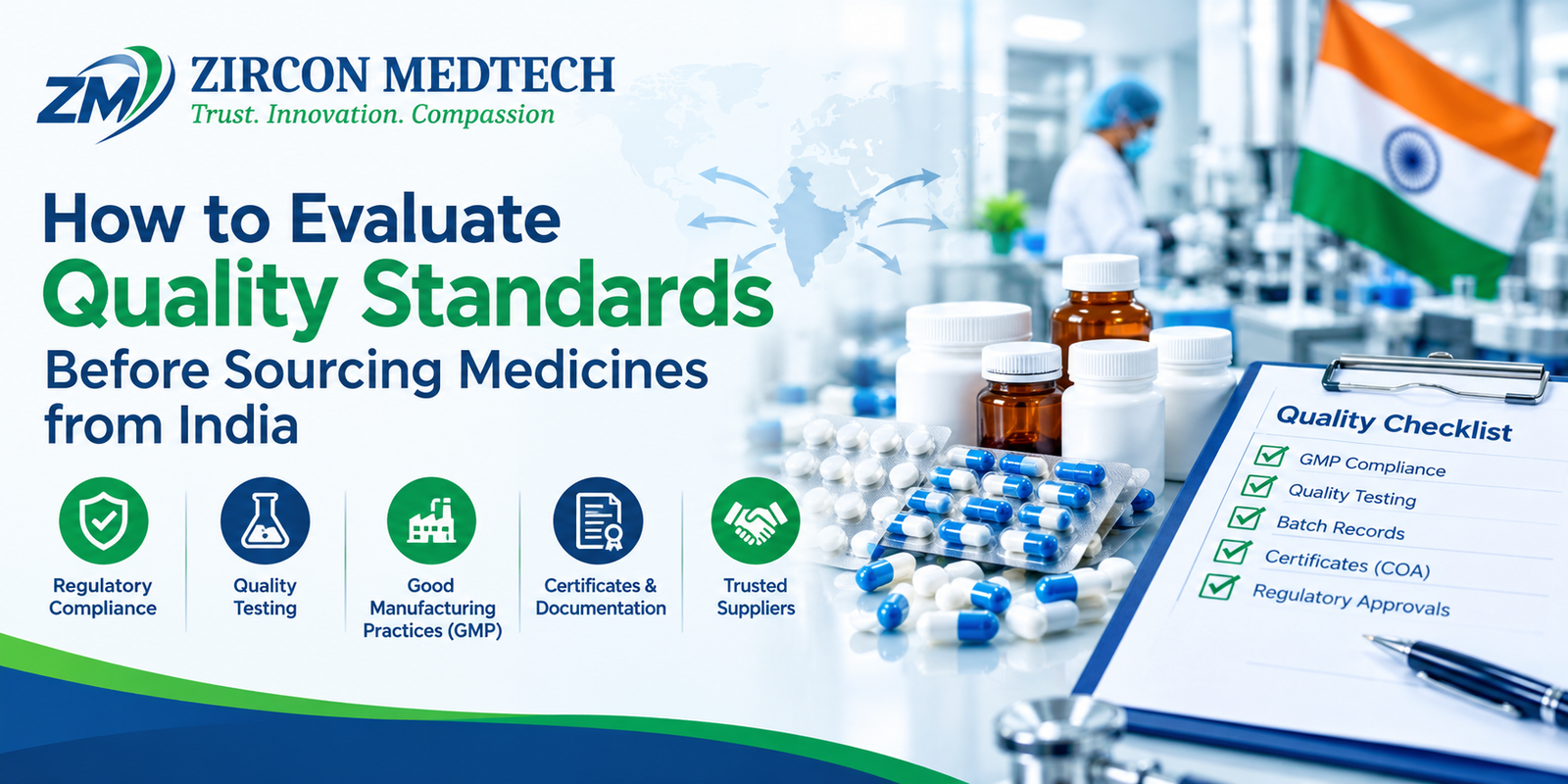
Why Evaluate Quality Standards Before Sourcing Medicines?
Pharmaceutical quality depends on the materials, manufacturing processes, testing procedures, packaging and handling used throughout the supply chain.
Good Manufacturing Practices, or GMP, help ensure that medicines are consistently produced and controlled according to appropriate quality standards. These practices cover production, quality control, suitable facilities, trained personnel and documented procedures.
For international buyers, reviewing quality evidence helps establish whether the proposed manufacturer and products are suitable for their sourcing requirements.
What International Buyers Should Check
Before sourcing medicines from India, buyers should carefully evaluate several important factors.
1. Manufacturer Identity and Authorisation
Buyers should identify the actual manufacturer of the medicines rather than assuming that the exporter operates the manufacturing facility.
Confirm the manufacturer’s legal name, facility address and relevant manufacturing authorisations. Check that the documents cover the products and dosage forms being purchased.
Where an exporter or distributor acts as an intermediary, buyers should also verify its legitimate relationship with the manufacturer. Company names and addresses should be consistent across relevant documents.
2. Manufacturing Standards
Review the evidence supporting the manufacturer’s GMP claims.
Check the issuing authority, manufacturing-site address, scope of activities and current status of the documentation. A certificate covering one facility or manufacturing activity should not be treated as evidence for every product supplied by the company.
Buyers should also interpret “WHO-GMP” claims carefully. Documentation based on WHO recommendations does not automatically mean that WHO directly inspected or certified the manufacturer. WHO prequalification is a separate process, and any such claim should be checked for the specific product concerned.
3. Product Specifications
Quality evaluation should focus on the exact medicine being ordered.
Buyers should confirm the active ingredient, strength, dosage form, formulation, quality specifications, packaging, shelf life and storage conditions.
Products with similar names may differ in important ways. Agreeing on detailed specifications before procurement helps prevent misunderstandings and supports consistent supply.
Depending on the product and destination market, additional technical information may be required, such as stability data or bioequivalence evidence where applicable.
4. Batch Testing and Certificates of Analysis
A Certificate of Analysis, commonly called a CoA, provides testing information for a particular batch.
Buyers should check that the product name, strength and batch number match the medicines being supplied. They should also review the specifications, reported results, relevant dates and document authorisation.
A sample CoA can support an initial supplier review, but documentation for the actual supplied batch should be obtained as agreed.
A CoA is one part of quality assessment. It does not replace appropriate manufacturing controls, regulatory authorisation or suitable handling arrangements.
5. Regulatory Requirements and Supporting Documents
Importers should establish what their destination country requires before committing to an order.
Depending on the country, product and import pathway, requirements may include product registration, import permissions, manufacturing-site evidence, technical documents and compliant labelling.
A Certificate of a Pharmaceutical Product, or CPP, may be relevant in some markets. Under the WHO Certification Scheme, this document provides information about the particular product and its status in the exporting country. It should not be treated as a universal approval to market the medicine internationally.
Buyers should confirm the applicable requirements with their local regulatory team and medicines authority.
6. Packaging, Storage and Supply Controls
Quality must be maintained after manufacturing and batch release.
Buyers should review whether packaging protects the medicine from relevant risks such as moisture, light, contamination or physical damage. Storage and transport arrangements should match the product’s stated requirements.
For temperature-sensitive medicines, agree on appropriate transport conditions, monitoring and procedures for assessing temperature deviations.
Buyers should also establish minimum remaining shelf-life requirements, batch traceability and responsibilities for damaged or unsuitable shipments.
Evaluating Supplier Quality Systems
Supporting documents are important, but buyers should also understand how the supplier manages quality issues.
Ask about procedures for handling complaints, investigating unexpected test results, notifying buyers of significant changes and coordinating recalls.
Depending on the product and identified risks, a technical assessment or supplier audit may be appropriate. Sterile medicines and other complex products may require more detailed review by qualified quality professionals.
A written quality agreement can clarify responsibilities for specifications, batch release, documentation, change notification, storage, transport and complaint handling.
Why Consistent Quality Monitoring Matters
Supplier evaluation should continue after the first order.
Buyers should monitor documentation accuracy, batch quality, packaging condition, communication and delivery performance. Changes to manufacturing sites, product specifications or regulatory status should trigger an appropriate review.
Maintaining organised records helps buyers identify recurring issues and decide whether corrective action or supplier reassessment is needed.
Why the Right Pharmaceutical Sourcing Partner Matters
Choosing a pharmaceutical sourcing partner involves more than finding the lowest price. Buyers should consider verified manufacturing standards, product-specific evidence, regulatory suitability and the supplier’s ability to manage quality throughout the supply chain.
A dependable exporter should communicate clearly, identify the actual manufacturer and provide the agreed documents without making unsupported certification claims.
For international businesses sourcing medicines from India, careful quality evaluation provides a stronger foundation for informed procurement and a reliable long-term supply relationship.








Share This News