OFFICE NO 5 & 6, 3RD FLOOR,
EARTH ALPHA COMPLEX
VASNA BHAYLI RD, VADODARA
GUJARAT, INDIA

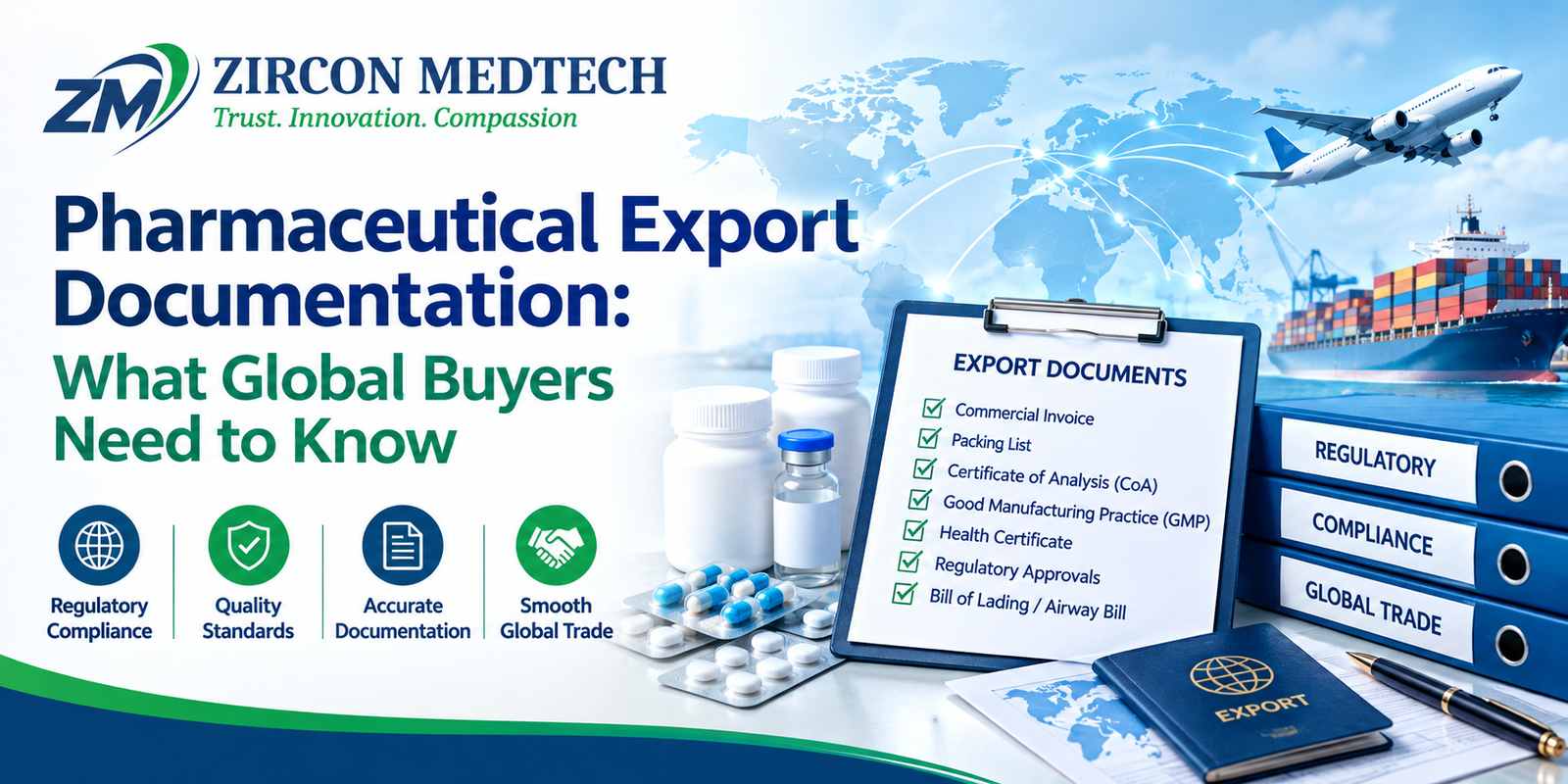
For international pharmaceutical buyers, importers, distributors and healthcare organisations, complete and accurate documentation provides important information about a product’s quality, manufacturing status, regulatory approval, batch details and shipping conditions.
Missing, inaccurate or inconsistent documents can cause customs delays, product rejection, financial losses, regulatory concerns and interruptions to the pharmaceutical supply chain.
The exact documentation required for a pharmaceutical shipment depends on the product type, exporting country, destination market, regulatory classification and commercial agreement between the buyer and supplier.
A document accepted in one country may not automatically satisfy the requirements of another market.
Global buyers should therefore confirm the documentation requirements with the relevant regulatory authority, customs authority and licensed importer in the destination country before placing a commercial order.
One of the most important documents is the commercial invoice.
A pharmaceutical commercial invoice generally identifies the exporter, importer, product name, dosage form, strength, pack size, quantity, unit price, total value, currency, country of origin, payment terms and agreed Incoterms.
The details on the commercial invoice should remain consistent with the packing list, shipping documents, product labels and import permit.
The packing list provides detailed information about how the products are packed for shipment.
It may include the number of cartons, quantity per carton, batch numbers, gross weight, net weight, package dimensions and pallet details.
Accurate packing information helps buyers, freight forwarders and customs authorities verify the shipment and identify any missing or damaged packages.
A Certificate of Analysis is another essential pharmaceutical document.
The Certificate of Analysis, commonly known as a CoA, reports the quality-control results for a specific batch of pharmaceutical products.
Depending on the product, it may include tests relating to identity, appearance, assay, impurities, dissolution, sterility, microbial limits, pH, particulate matter or other approved specifications.
Buyers should confirm that the product name, strength, batch number, manufacturing date and expiry date shown on the CoA match the physical product and other shipment documents.
The CoA should be issued or approved by an authorised quality-control or quality-assurance representative.
A Good Manufacturing Practice certificate may also be required to demonstrate that the manufacturing facility operates according to applicable pharmaceutical manufacturing requirements.
Buyers should verify the certificate’s issuing authority, facility name, manufacturing address, approved dosage forms, scope of operations and validity period.
A GMP certificate covering tablets and capsules does not necessarily demonstrate approval for sterile injections, oncology medicines, biological products or other specialised dosage forms.
The manufacturing licence should also be reviewed.
This document helps confirm that the facility is authorised by the appropriate regulatory authority to manufacture the relevant pharmaceutical products or dosage forms.
The name and address on the manufacturing licence should correspond with the actual manufacturing site and supporting quality documents.
A Certificate of Pharmaceutical Product may be requested during product registration or import-approval procedures.
The World Health Organization describes its Certification Scheme as a voluntary international agreement intended to provide assurance about pharmaceutical products moving in international commerce. The primary document under this scheme is the Certificate of Pharmaceutical Product, commonly called a CPP. WHO Certification Scheme
A CPP may provide information about the product’s licensing status, manufacturing arrangements and regulatory position in the exporting country.
However, a CPP does not automatically authorise the sale or import of a medicine in every destination market.
The importing country may still require product registration, local testing, manufacturing-site approval, import licences, labelling approval or additional technical documents.
A Certificate of Origin may be required to confirm the country in which the pharmaceutical product was manufactured or produced.
This certificate may be issued or authenticated by a chamber of commerce, government department or another authorised organisation, depending on the exporting country and destination-market requirements.
Customs authorities may use the Certificate of Origin to determine tariff treatment, trade-agreement eligibility or country-specific import controls.
Pharmaceutical shipments may also require a valid import licence or import permit.
This document is generally obtained by the buyer, local representative or licensed importer from the relevant authority in the destination country.
Before dispatching products, the exporter should verify that the permit is valid, covers the correct product and quantity, and identifies the appropriate manufacturer, importer and destination.
Certain products may require additional permits.
Controlled medicines, narcotics, psychotropic substances, vaccines, biological products, investigational medicines and hazardous pharmaceutical materials may be subject to specialised import and export controls.
For these products, buyers and exporters should confirm all regulatory permissions before manufacturing, payment or shipment.
Shipping documents are also necessary for the physical movement of pharmaceutical products.
Depending on the transport method, these documents may include a bill of lading, airway bill, courier receipt, freight certificate or multimodal transport document.
The names, addresses, product descriptions, package numbers and shipment details should be consistent across all records.
Insurance documentation may be required when the shipment is covered against loss, damage, theft or temperature-related risks.
The insurance policy or certificate should clearly identify the insured parties, shipment value, coverage period, transport route and applicable exclusions.
Temperature-sensitive pharmaceutical products require additional documentation.
Vaccines, biological medicines, insulin, certain injections and other cold-chain products must be transported and stored within specified temperature conditions.
Relevant records may include temperature-monitoring reports, data-logger records, packaging-validation documents, route-risk assessments and evidence of qualified shipping arrangements.
Global buyers should determine how temperature data will be accessed, reviewed and approved when the shipment arrives.
Any temperature excursion should be investigated through an established quality procedure before the affected products are released for distribution.
Product specifications and approved artwork may also form part of the export-documentation package.
Packaging and labelling information may need to include:
Buyers should confirm that the labels and packaging comply with the destination country’s regulatory and language requirements.
A product approved with English packaging in one market may require translated labels, local registration details or different patient information in another country.
Stability data may be required to support the proposed shelf life and storage conditions of the pharmaceutical product.
This information is particularly important when medicines are exported to countries with hot, humid or otherwise challenging climatic conditions.
Buyers should confirm whether available stability studies support the climatic zone and storage requirements of the intended market.
For some transactions, the buyer may also request product dossiers, validation summaries, method-validation documents, safety data sheets, batch-manufacturing records or certificates relating to specific materials.
These requirements should be agreed upon before the order is finalised because confidential technical documents may be subject to controlled-access procedures.
A free-sale certificate may be requested in certain markets.
This document generally indicates that a product is legally marketed or permitted for sale in the exporting country, although its meaning and acceptance can differ between jurisdictions.
Buyers should confirm whether the destination authority requires a free-sale certificate, CPP or another regulatory document.
Document authentication may also be necessary.
Depending on the importing country, documents may require notarisation, apostille, chamber-of-commerce authentication, embassy legalisation or verification by a regulatory authority.
These processes can require additional time and cost, so they should be identified early in the export-planning stage.
Buyers should carefully check that all documentation uses consistent information.
Common documentation problems include:
Even a minor inconsistency can delay customs clearance or create questions about product authenticity and traceability.
Electronic documents are increasingly used in international pharmaceutical trade.
However, buyers should confirm whether the destination authority accepts electronic signatures, digital certificates and scanned documents or requires original paper copies.
The WHO notes that certificate formats and wording can vary between national authorities. When the validity of a certificate is uncertain, verification should be requested through the competent regulatory authority rather than relying only on a copy supplied by a commercial party. World Health Organization
Before approving a pharmaceutical supplier, global buyers should create a document-verification checklist.
This checklist may cover the manufacturing licence, GMP certificate, product-registration status, Certificate of Analysis, CPP, Certificate of Origin, stability data, product specifications, approved packaging, shipping records and required import permissions.
Documents should be reviewed by qualified regulatory, legal and quality professionals who understand the requirements of the destination market.
Global buyers should also maintain organised records after the shipment is received.
Documentation may be required during customs reviews, regulatory inspections, product complaints, recalls, pharmacovigilance investigations or supplier audits.
A reliable pharmaceutical exporter should be able to provide clear, accurate and traceable documentation within the agreed timeline.
However, responsibility is shared across the supply chain.
Manufacturers, exporters, importers, distributors, freight providers and regulatory representatives must coordinate to ensure that the product and its documentation remain consistent from production through final delivery.
Pharmaceutical export documentation is more than an administrative requirement.
It provides evidence of product identity, quality, regulatory status, shipment conditions and supply-chain traceability.
For global buyers, reviewing documents before placing and dispatching an order can help reduce customs delays, prevent compliance problems, protect product quality and establish a more dependable pharmaceutical supply chain.
Selecting an experienced pharmaceutical manufacturing and export partner can help international buyers receive the appropriate quality, regulatory and commercial documentation for their target markets.
Final requirements should always be confirmed with the competent authorities and qualified professionals in both the exporting and importing countries.








Share This News